

YUNNAN - Fungi Kingdom
Yunnan, located in southwest China, is one of the world's most biodiverse regions, blending tropical, subtropical, and temperate zones. Known as the "Kingdom of Wild Fungi," it is home to over 250 species of edible fungi, nurtured by high-altitude forests, clean environments, and rich soils.
Today, Yunnan yields around 65% of the world's black truffles. Its forests sit between 2,000 and 3,000 meters above sea level, with a mild yearly temperature of 8–19°C, an annual rainfall of 800–1,200 mm, and alkaline, well-drained soils. These conditions—paired with native oak, hazel, and pine trees—create an ideal habitat that remains remarkably stable. Unlike traditional truffle regions like France, where shifting weather patterns and droughts have increasingly impacted yields, Yunnan's predictable wet summers and long dry winters align harmoniously with the truffle's natural lifecycle, ensuring steady production and consistent quality.

START FROM WASTE
Here’s a fact you might not know—black truffles aren’t as rare as you think. Every year, countless truffles go to waste in YUNNAN because they are difficult to preserve and transport.
Black truffles are extremely delicate. Once harvested, they start losing moisture, aroma, and flavor within a few days. Truffles also continue to break down after harvest, making them highly perishable. Even under refrigeration, fresh truffles only stay at peak quality for about 10 to 14 days. In Yunnan, due to limited storage solutions and low local demand, large amounts of black truffles are wasted or even used as pig feed every year.
Based on our analysis, among good, mature-quality truffles that go to waste, 89% cannot be sold due to imperfect appearance or size, 63% because of poor preservation options, and 38% due to inefficient transportation that causes them to perish. These challenges make it costly to bring it to market in its best condition.
RACE AGAINST TIME
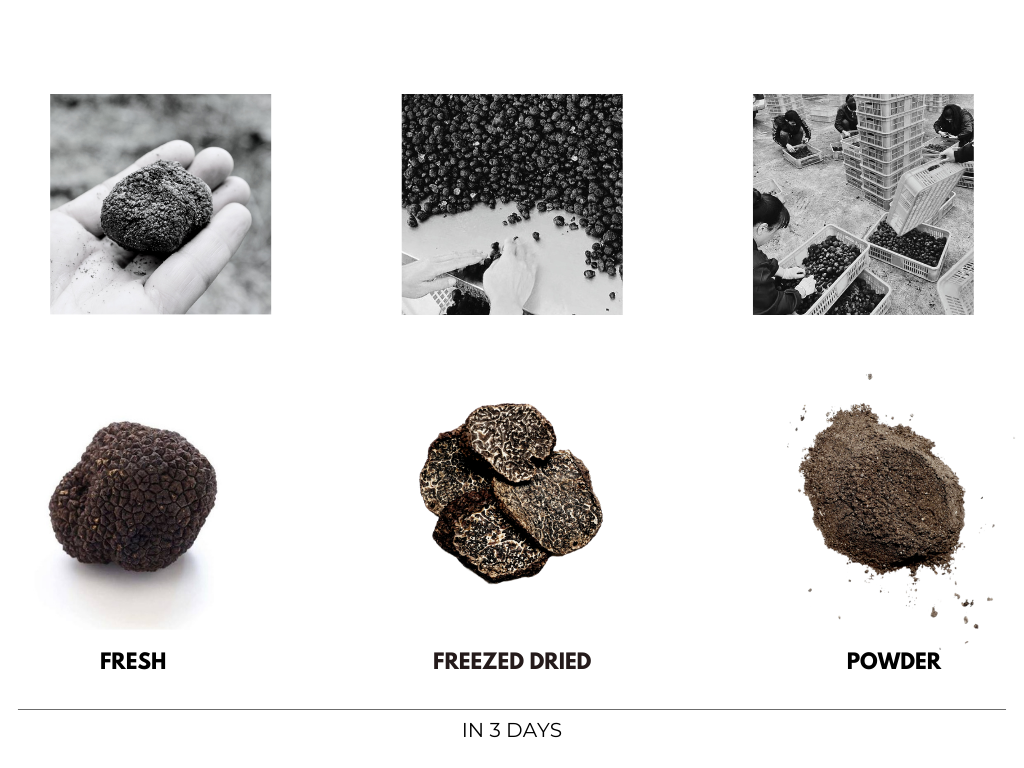
Rescue the truffles in three days
After harvesting, truffles are carefully sorted by size (2–3 cm, 15–25 grams) and swiftly transported to our facility. There, they undergo a secondary quality check to ensure consistency.
Next, we gently and efficiently clean the truffles with soft brushes and purified water, keeping their delicate structure and rich aroma intact. They are then thinly sliced and preserved using our proprietary MOSU technique—locking in their full flavor, nutrients, and fragrance.
Finally, the truffles are finely ground into powder, capturing the pure essence of fresh black truffles in a stable, daily-ready form.

AROMATIC JOURNEY
Unfolds with a fresh earthy top note of damp forest earth and crisp, weathered tree bark, immediately evoking the raw, untamed magic of the autumn woods.
As the scent deepens, it transitions into a luscious heart of rich, velvety dark chocolate—warm, decadent, and deeply comforting.
Finally, it settles into a lingering, sophisticated finish of roasted nuts, leaving a buttery, toasted warmth, and a subtle sweetness on the senses.
The overall experience is seamlessly balanced and smoothly silky—an exquisite interplay of earthy wilderness and quiet everyday comfort.
